
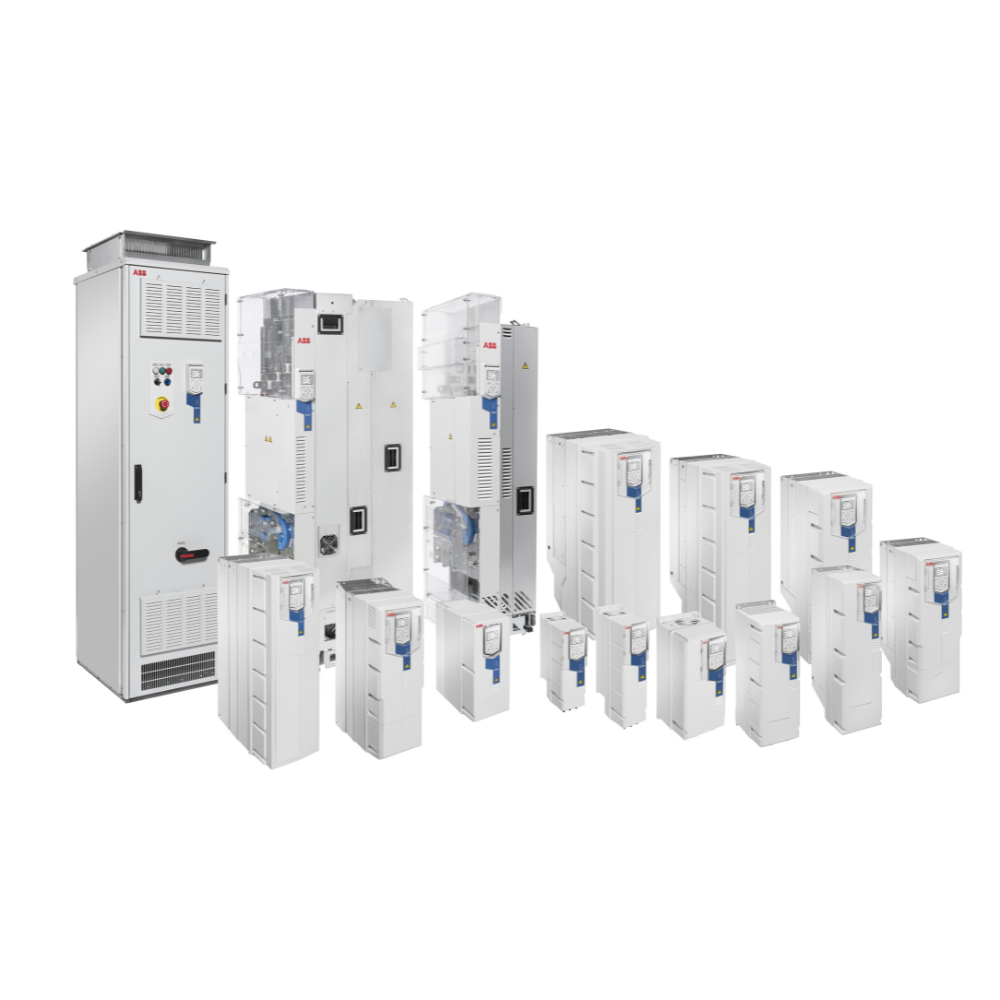
Choosing the correct variable frequency drive (VFD) is no longer just about matching the kilowatt rating to the motor. In modern industrial automation, the drive acts as the brain of the operation. Selecting the wrong unit can lead to integration nightmares, premature hardware failure, and inflated energy costs.
ABB’s low-voltage AC drive portfolio—built on their innovative “all-compatible” architecture—offers an incredible range of solutions. However, navigating this extensive catalog requires a systematic approach.
At Vaer Industrial, we guide our partners through a structured four-step engineering process to ensure they select the exact drive configuration for maximum performance and return on investment (ROI).
Step 1: Define the Core Application (Selecting the Base Series)
The first step is matching the drive’s internal firmware and power capacity to the specific mechanical load of your application.
- For Standalone Machines and OEMs (Sub-22 kW): If you are building localized, compact machinery like conveyors, mixers, or material handling equipment, space is at a premium. The ACS180 and ACS380 are designed for dynamic, side-by-side cabinet integration.
- For Standard Manufacturing Floors: If you need a scalable workhorse for fans, compressors, or standard extruders, the ACS580 is the definitive choice. Ranging up to 500 kW, this general-purpose drive features built-in harmonic mitigation, simplifying panel design.
- For Fluid and Air Management: Do not use a generic drive for complex pumping or HVAC systems. The ACQ580 is purpose-built for water/wastewater, featuring integrated anti-cavitation and multipump logic. For building automation and climate control, the ACH580 natively supports BACnet and PID loop controls.
- For Heavy-Duty Industrial Demands: When dealing with massive loads like heavy winches or complex cast line extruders, the ACS880 is the mandatory choice. Scaling up to 5600 kW, it utilizes Direct Torque Control (DTC) for uncompromising mechanical precision at zero speed.
Step 2: Evaluate the Operating Environment (Selecting the Enclosure)
A drive’s lifespan is heavily dictated by its physical environment. Deploying a standard electrical panel drive in a harsh environment is a guaranteed path to failure.
- Clean Electrical Rooms: Standard IP20 or UL Type 1 enclosures are highly cost-effective and perfectly suitable for climate-controlled MCC (Motor Control Center) rooms.
- Dust and Light Moisture: If the drive is mounted on the factory floor where dust or occasional splashing occurs, upgrading to an IP55 (UL Type 12) enclosure ensures internal electronics remain uncontaminated.
- Wash-Down and Extreme Conditions: For food processing, bio-energy plants, or high-humidity tropical environments, decentralized mounting requires absolute protection. We mandate IP66/67 (UL Type 4X) enclosures, often paired with pressure compensation valves to prevent internal condensation.
Step 3: Map the Network Architecture (Communication & I/O)
A modern VFD must communicate seamlessly with your overarching PLC or SCADA system. Buying a drive that cannot speak your system’s native language leads to costly external gateways and delayed commissioning.
- Industrial Ethernet: For high-speed, data-rich environments, ensure the drive is configured with adapters for PROFINET IO, Modbus TCP, or EtherNet/IP.
- Legacy and Serial Networks: If integrating into older infrastructure, specify fieldbus modules for PROFIBUS-DP, Modbus RTU, or DeviceNet.
- Closed-Loop Precision: If your application requires absolute positioning (like a CNC spindle or synchronized web handling), the drive must be configured with specific HTL, TTL, or absolute encoder feedback modules to close the control loop.
Step 4: Integrate Safety and Specialized Logic
Modern safety standards demand that electrical isolation happens at the drive level, protecting both personnel and high-value physical assets.
- Built-in Safety: Ensure the drive supports Safe Torque Off (STO) as a standard feature, which prevents the motor from generating torque during emergency stops without cutting main power to the drive.
- Advanced Logic: If operating in explosive environments, ATEX-certified thermistor protection modules are required. For complex applications, you can leverage specialized firmware—such as specific loads for high-speed spindles, solar pump MPPT tracking, or enhanced sequence programming—to eliminate the need for an external PLC.
The Bottom Line: Engineering Over Procurement
Buying an ABB drive out of a catalog is procurement; configuring it to survive your environment, communicate with your network, and protect your machinery is engineering.
By systematically evaluating the mechanical load, environmental threats, and communication requirements, facilities can eliminate downtime and maximize their energy efficiency. Partnering with expert integrators ensures that every option code, fieldbus adapter, and safety module is perfectly tailored to your exact operational reality