Industrial businesses realise the critical importance of energy efficiency as an immediate step to improve their sustainability, contribute to reaching net zero, and boost profitability. Worldwide, motors and the systems that they drive are responsible for approximately 45 percent of all electricity consumption. Zooming in on the industrial sector specifically, around 70 percent of all electricity used is consumed by electric motor systems.
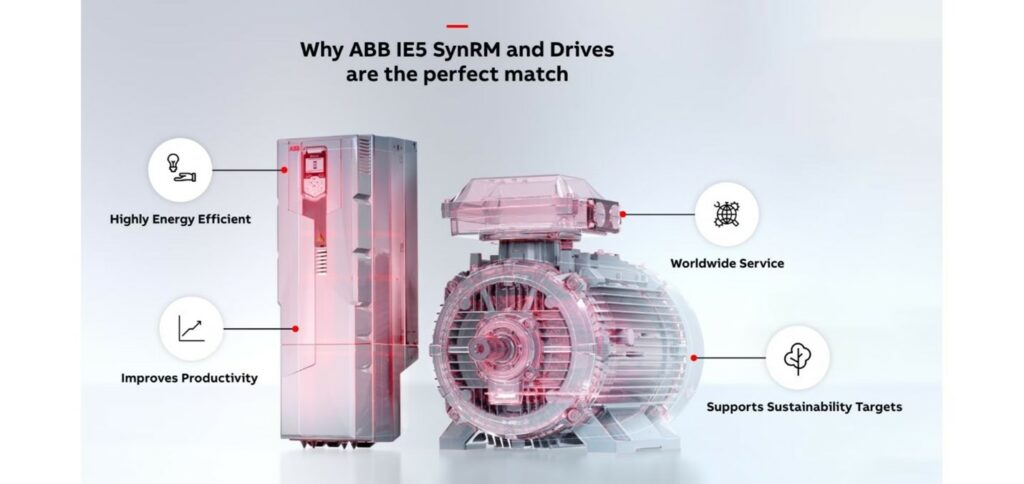
Fortunately, modern motors, such as synchronous reluctance (SynRM) motors, are significantly more efficient than older technology. The impact of upgrading is massive: if 80 percent of today’s installed industrial motors were replaced by IE5 units, the estimated annual energy saving would equate to the annual power consumption of Poland.
Here is a comprehensive engineering and financial breakdown of why upgrading to IE5 SynRM technology is a critical step for modern plant operations.
1. Decoding the Total Cost of Ownership (TCO)
Buyers are sometimes reluctant to invest in new motors and drives, due to the upfront cost. However, evaluating an upgrade based on procurement cost is highly deceptive, as the upfront cost is just a small fraction of the overall total cost of ownership (TCO).
- Long-Term Profitability: Once the motor has paid for itself, it continues to produce savings throughout its operational life, which is often over 20 years.
- The 97% Rule: For efficient motors, the upfront cost of the motor is just two percent of its TCO. Maintenance accounts for one percent, and the remaining 97 percent goes entirely to the electricity used to power the motor.
- Rapid Payback: Because energy represents almost the entire lifecycle cost, more efficient motors pay for themselves through operational expenditure (OpEx) savings. Payback periods can be as short as a matter of months when energy prices are high. Generally, the additional cost of specifying an IE5 SynRM and drive package instead of an IE3 motor and VSD can have a payback time as short as one year.
2. The Mechanical Innovation: Rethinking the Rotor
From the outside, a SynRM motor looks very much like an induction motor. Inside, however, the innovative rotor structure is very different, as it has no windings at all.
- Eliminating Heat and Energy Loss: In conventional induction motors, heavy currents flow due to the squirrel cage rotor design and the short circuit formed by its end rings. These currents account for around 40 percent of the motor’s energy losses, resulting in the generation of additional heat. By contrast, SynRM rotors have no squirrel cages or windings to generate currents and heat, so energy losses are virtually nil.
- Extended Mechanical Lifespan: Because they run at cooler temperatures than induction motors, it extends the life of stator windings, bearing lubricants, and the bearings themselves. This relatively simple construction also makes IE5 SynRM motors easier to service and extends their servicing intervals.
- Sustainable Material Sourcing: Unlike permanent magnet (PM) motors, the SynRM rotor does not contain magnets or rare earth elements (REEs), such as neodymium. This contributes to sustainability, as the production of rare earth metals has a serious environmental impact and limited potential for recycling.
3. Precision Control with Variable Speed Drives (VSDs)
A SynRM motor is always installed with a VSD to form an optimised package.
- Load Matching: In pump, fan and compressor applications, a drive can reduce power consumption by typically 25 percent or more by adjusting the motor’s speed and torque to match the load.
- Sensorless Precision: ABB’s direct torque control (DTC) precisely governs speed and torque, without speed sensors, encoders, or other feedback devices.
- Full Range Accuracy: They are highly accurate and efficient across the whole speed range, even with partial loads, and can supply constant torque with precise control in demanding applications, such as extruders, mixers, winches, and conveyors.
4. Proven Field Results and Case Studies
Industrial case studies with SynRM motor and VSD packages have shown typical reductions in energy bills from 14 to 25 percent, compared to the replaced motors.
- Food & Beverage Processing: Campbell’s implemented a package in a refrigeration compressor at its Shepparton plant in Australia, noting a 14 percent reduction in energy costs, as well as reductions in running temperature, vibration, and noise.
- Water Utilities: Evides Waterbedrijf in the Netherlands used similar pump and drive packages for vital machinery, resulting in an estimated 20 percent energy saving. The cooler running was expected to extend motor and bearing life, which was critical for their 20-30-year life expectancy requirements.
- Heavy Extrusion: Radius Systems replaced a troublesome DC motor on an extrusion line, delivering an estimated energy saving of eight to 15 percent while saving around £2,000 annually on maintenance.
- Overcoming Grid Limits: PrimePac had problems with a hydraulic motor on a blow moulding machine that consumed excessive energy and produced poor bottle quality. A SynRM package delivered an energy saving peaking at 60 percent, which enabled the facility to install a new extruder without having to spend £250,000 on upgrading the site’s power supply.
- Regenerative Systems: A Finnish sawmill operator adopted ABB IE5 SynRM motor-drive packages paired with drives that enable regenerative braking. These upgrades are estimated to produce six-figure energy savings within the first couple of years.
5. Seamless Drop-In Integration
Upgrading from an older induction motor is straightforward. IE5 SynRM motors are available in the same standard dimensions and output power classes, meaning that they can be drop-in replacements in many cases. There is no need for mechanical modifications to existing setups.
Proven Field Results and Case Studies
The transition to IE5 SynRM and advanced drive packages is easily justified from a financial perspective. The expense of purchasing a motor is just a tiny fraction of its lifetime cost, and the main operating expense is energy. While an IE5 SynRM-drive package may cost slightly more up front, reduced energy consumption will often pay for the difference in as little as a year.
We validate these projections through rigorous Proof of Concept (POC) deployments, allowing facilities to witness the exact kilowatt reductions on their own infrastructure before committing to plant-wide upgrades.
The real-world potential is substantial, particularly for high-capacity industrial applications. Recently, at a leading bio-energy processing facility in East Malaysia, we executed a targeted, temporary POC on a critical heavy-duty pumping system. The facility’s baseline configuration utilized a 185kW induction motor paired with an electronic softstarter. While the softstarter effectively manages initial inrush current, it still drives the motor at a continuous full speed during operation.
To demonstrate the potential for optimization, we temporarily integrated a 160kW ABB IE5 SynRM motor paired with a robust 200kW ABB ACQ580 variable speed drive to run in comparison. By allowing the system to automatically modulate motor speed to match real-time fluid dynamics, rather than running at a fixed speed, the trial recorded a massive reduction in baseline kilowatt-hour consumption and significantly cooler operating temperatures. This empirical data proves that by upgrading from fixed-speed softstarter configurations to intelligent, high-capacity variable speed automation, industrial operators can conclusively slash their energy overhead, achieving total system payback in remarkably short timelines while ensuring compliance with modern sustainability mandates.