When a modern Navy vessel—whether a frigate, destroyer, or submarine—docks at a Navy base, maintaining operational readiness is non-negotiable. The vessel’s combat arrays, navigation systems, and life support must remain fully powered.
However, this presents a massive logistical challenge in many regions. Internationally, many ships are designed to operate on a 60 Hz power supply, while the standard onshore grid in regions like the Middle East and Asia is only 50 Hz.
Historically, Navy bases had two options to bridge this frequency gap: run the ship’s onboard diesel generators while berthed, or use heavy onshore rotary frequency converters. Today, both of these legacy methods are severe operational liabilities.
At Vaer Industrial, we provide the modern defense solution:
ABB PCS100 SFC (Static Frequency Converter).
The Tactical Disadvantage of Legacy Systems
Relying on onboard diesel generators burns thousands of dollars in fuel daily, accumulates unnecessary engine wear, and creates a massive thermal and acoustic signature that disrupts secure base operations.
To avoid burning fuel, many Navy bases installed rotary frequency converters. But for a rotary system, efficiency is generally only around 75 percent. Furthermore, these legacy systems are not environmentally friendly due to nitrogen dioxide gas emissions, and the constant mechanical wear makes equipment reliability a major issue.
The Solid-State Navy Advantage
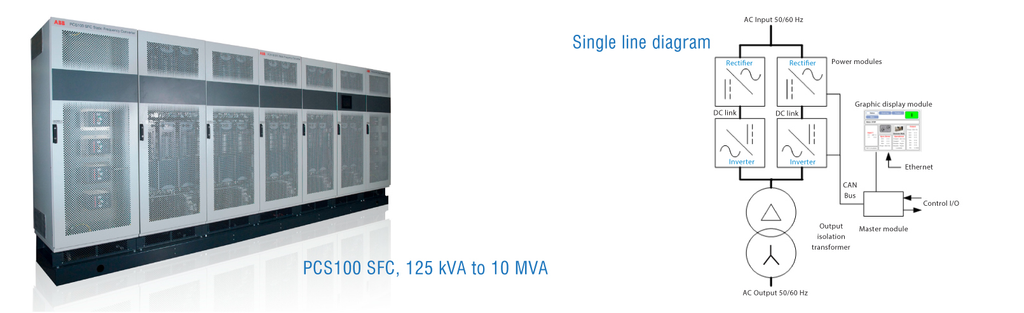
The ABB PCS100 SFC replaces mechanical rotation with solid-state power electronics, offering distinct tactical and engineering advantages for military ports:
Climate Resilience: Navy bases in tropical or arid environments require hardened equipment. The modular PCS100 SFC can be custom-engineered for extreme climates. In one harsh Middle Eastern installation, the SFCs were successfully de-rated to suit high ambient temperatures, ensuring continuous power without thermal tripping
Combat-Grade Clean Power: Navy radar and weapons systems require pristine electrical feeds. The PCS100 SFC provides precise control of frequency and voltage, creating a clean power supply to isolate an unstable grid from a critical load.
Zero Acoustic Signature: Since the PCS100 SFCs eliminate all rotating equipment from the system, they produce virtually no mechanical noise. This allows for silent port operations, reducing crew fatigue and maintaining Navy base security protocols.
Maximum Efficiency: Unlike the 75 percent efficiency of rotary systems, the efficiency of the PCS100 SFC is much higher—up to 95 percent. This drastically reduces the operating and maintenance cost of the equipment over time.
Ensuring Mission Readiness
For Navy fleet commanders and base engineers, standardizing shore-to-ship power is a matter of national security. Eliminating rotating equipment means there is no longer any need for mechanical maintenance, resulting in high reliability and greater availability of the equipment.
Vaer Industrial specializes in engineering ABB grid connection technology for demanding maritime environments. By upgrading to static frequency conversion, Navy facilities can ensure their fleets remain powered, protected, and combat-ready the moment they drop lines.