Moving and processing the incredible volumes of water required by modern society is an extremely energy-intensive undertaking. Research by the International Energy Agency (IEA) suggests that as much as 4% of the world’s total electrical energy is used by the water and wastewater segments. For facility operators, this is not just an environmental metric; it is a critical financial burden. Today, electricity makes up an average of 45% of a water processing facility’s operating cost.
As local regulatory frameworks, including guidelines set by Suruhanjaya Tenaga, increasingly prioritize high-efficiency infrastructure, municipal and industrial water operators must transition away from legacy systems. Experts estimate that energy consumption by the sector could be cut by as much as 15% by 2040 if energy efficiency and recovery measures are adopted worldwide. Achieving these benchmarks requires the deployment of Ultra-Premium Efficiency Synchronous Reluctance (SynRM) motors paired with intelligent, industry-specific variable speed drives (VSDs).
The Inefficiency of Legacy Pump Control
A significant portion of the electricity used in the water and wastewater industries goes toward powering pumps. Historically, these pumps are driven by standard induction motors that run continuously at full speed, regardless of actual load requirements. To control the water flow in these outdated configurations, operators are forced to apply downstream throttling. This method is fundamentally inefficient, operating much like using a car’s brakes while keeping the other foot firmly on the accelerator. The motor consumes the same massive amount of power regardless of the actual output water flow, resulting in severely wasted electricity.
The Non-Linear Math of Energy Savings
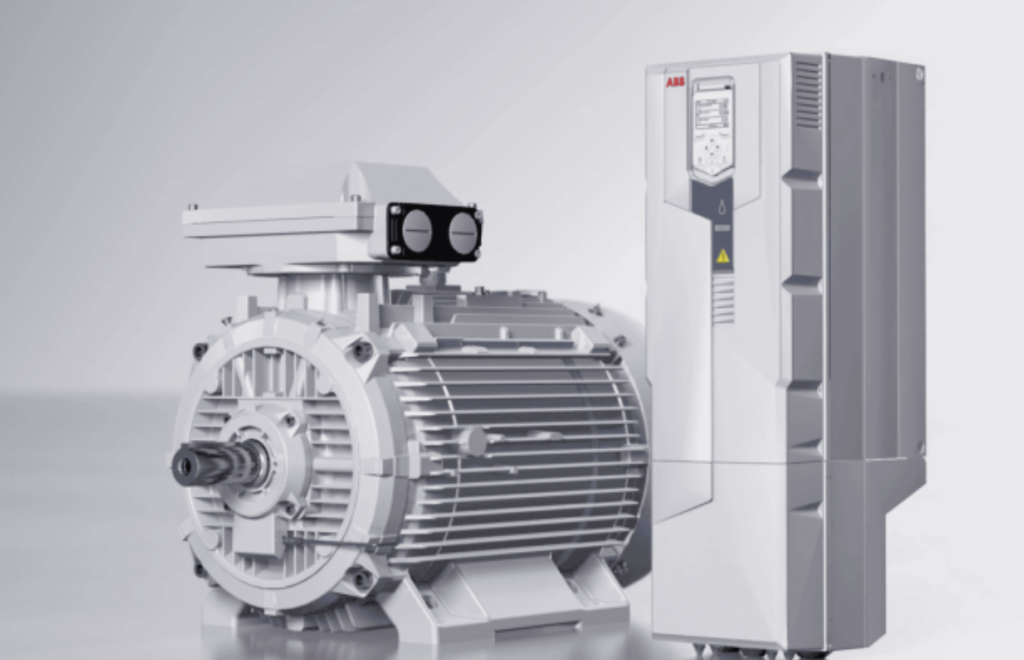
By upgrading to an advanced variable speed drive, operators can adjust the motor’s speed directly to match the precise flow and pressure requirements. Because the relationship between motor speed and energy consumption in pump applications is non-linear, the energy savings are exponential. Using a drive to reduce the motor’s speed by just 20% cuts energy use by 50%. When these drives are paired with ABB’s IE5 SynRM technology, the baseline efficiency is elevated even further. If a facility upgraded from the minimum specified IE3 motors to IE5 SynRM motors, energy losses would be reduced by approximately 40%.
Purpose-Built Automation: The ACQ580 Advantage
To maximize the benefits of IE5 motors in water applications, standard inverters are insufficient. The ABB ACQ580 series is engineered specifically for the water industry. Capable of scaling up to massive 500kW continuous loads, these all-compatible drives go beyond simple speed modulation. They are equipped with embedded, water-specific logic, including:
- Sensorless flow calculation
- Multipump control to manage cascading demand without external PLCs
- Level control and soft pipe fill to prevent catastrophic water hammer events
- Dry run protection and automated pump cleaning sequences to dislodge impeller blockages
These plug-and-play features mean that they can easily be added to existing installations, new projects, and OEM designs.
Validating the ROI Through Proof of Concept
The transition to IE5 SynRM and advanced drive packages is easily justified from a financial perspective. The expense of purchasing a motor is just a tiny fraction of its lifetime cost, and the main operating expense is energy. While an IE5 SynRM-drive package may cost slightly more up front, reduced energy consumption will often pay for the difference in as little as a year.
We validate these projections through rigorous Proof of Concept (POC) deployments, allowing facilities to witness the exact kilowatt reductions on their own infrastructure before committing to plant-wide upgrades.
The real-world potential is substantial, particularly for high-capacity industrial applications. Recently, at a leading bio-energy processing facility in East Malaysia, we executed a targeted, temporary POC on a critical heavy-duty pumping system. The facility’s baseline configuration utilized a 185kW induction motor paired with an electronic softstarter. While the softstarter effectively manages initial inrush current, it still drives the motor at a continuous full speed during operation.
To demonstrate the potential for optimization, we temporarily integrated a 160kW ABB IE5 SynRM motor paired with a robust 200kW ABB ACQ580 variable speed drive to run in comparison. By allowing the system to automatically modulate motor speed to match real-time fluid dynamics, rather than running at a fixed speed, the trial recorded a massive reduction in baseline kilowatt-hour consumption and significantly cooler operating temperatures. This empirical data proves that by upgrading from fixed-speed softstarter configurations to intelligent, high-capacity variable speed automation, industrial operators can conclusively slash their energy overhead, achieving total system payback in remarkably short timelines while ensuring compliance with modern sustainability mandates.